Care & Troubleshooting
Mold in a Terrarium: Normal or a Problem?
Found fuzzy growth inside the glass? Learn when terrarium mold is simply decomposing organic material, when it signals excess moisture, and what to do next.
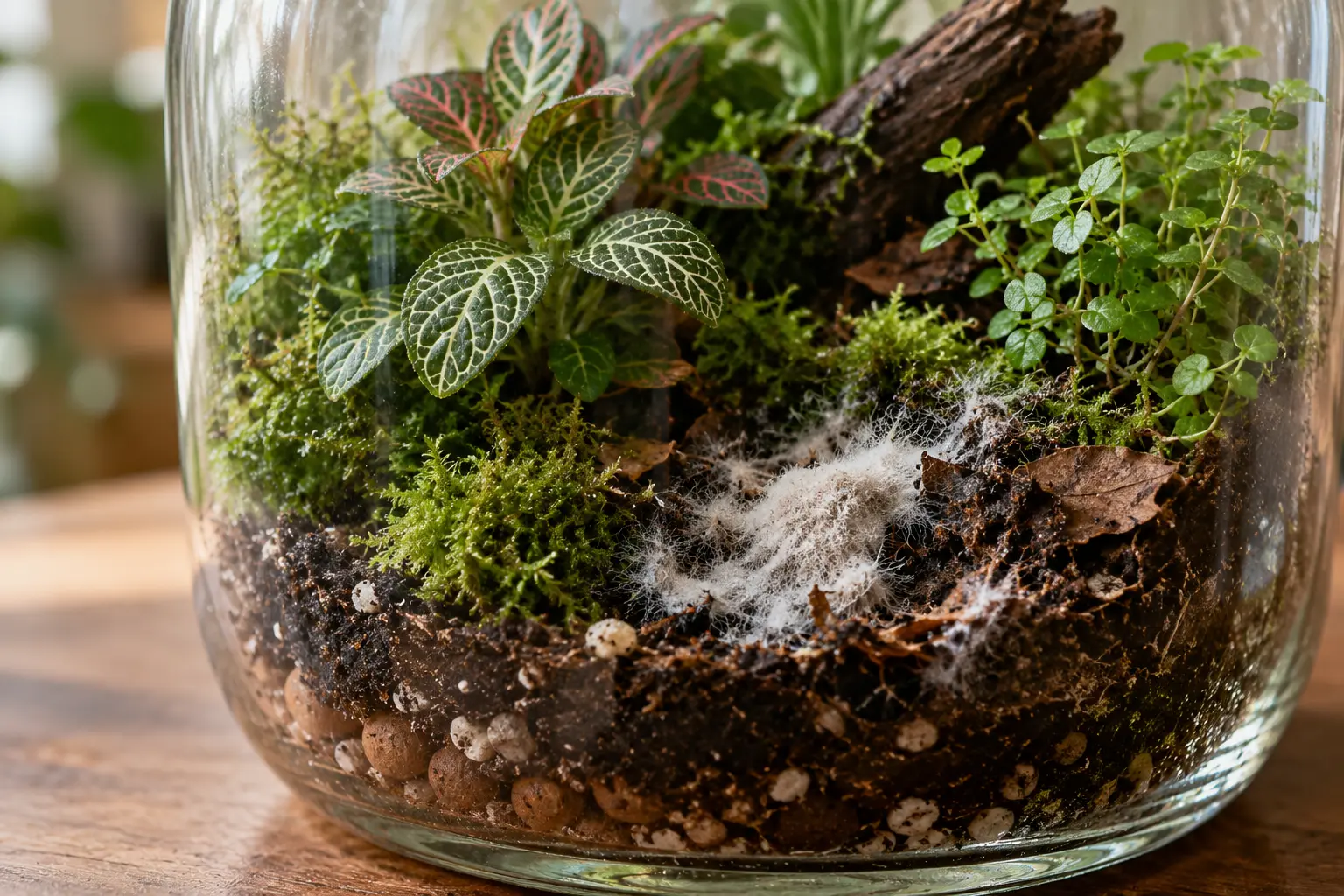
Finding a patch of white fuzz inside a terrarium can make a healthy-looking miniature garden suddenly feel like a failed experiment.
Usually, the first question is simple:
Do I need to panic?
Usually not.
A terrarium is warm, humid, moist, and full of organic material. Those same conditions that support tropical plants also support fungi.
Some fungi are decomposers that feed primarily on dead organic material. A small patch growing on a dying leaf, piece of wood, or other decomposing material does not automatically mean your plants are diseased.
But mold should not simply be ignored either.
If fungal growth keeps spreading, repeatedly returns, covers living plant tissue, or appears alongside saturated substrate, dying plants, mushy roots, or constant excessive condensation, the terrarium needs attention.
The goal is not to create a sterile jar.
The goal is to keep the environment balanced enough that plants remain healthy and fungal growth does not take over.
Quick answer: What should you do about mold in a terrarium?
Start with this order:
- Find exactly where the growth is occurring.
- Remove dead or decaying plant material.
- Remove localized visible mold when practical.
- Check whether the substrate is overly wet or water is pooling below it.
- Temporarily open the terrarium if it is excessively wet.
- Give the system time to respond before adding more treatments.
- Consider springtails as a biological cleanup helper.
- Escalate if mold continues spreading or the plants themselves are rotting.
Do not add more water while trying to solve an excessive-moisture problem.
And do not assume the color of the mold tells you exactly what organism you are looking at.
Is mold normal in a closed terrarium?
A small amount can be.
Fungi are part of decomposition in natural ecosystems.
They break down organic material and participate in nutrient cycling. Penn State Extension describes saprophytic fungi as decomposers that consume organic matter rather than causing disease in living plants.
A terrarium contains plenty of potential fungal food:
- Dead leaves
- Dying roots
- Wood
- Bark
- Organic substrate
- Moss debris
- Other plant material
Add high humidity and moisture, and fungal growth becomes possible.
The Royal Horticultural Society specifically advises terrarium owners to remove dead leaves and plant debris promptly to avoid rot and mould.
So the useful question is not:
“Is there any fungus in my terrarium?”
It is:
“Where is it growing, how much is there, and what is happening to the plants around it?”
Why does mold grow in a terrarium?
Mold requires favorable environmental conditions.
A closed terrarium provides several of them naturally.
Moisture
Moisture is the biggest variable under your control.
A sealed terrarium recycles water rather than allowing it to drain freely into the room.
That is one reason closed terrariums need surprisingly little additional watering.
If too much water enters the system, surfaces can remain excessively wet for extended periods.
The RHS advises watering closed terrariums sparingly and temporarily opening the lid when condensation becomes excessive.
Organic material
Fungi need something to grow on or consume.
Dead leaves, decomposing stems, some woods, bark, and organic substrate can all provide material.
This is why a small patch of mold often appears first on a dead leaf or piece of hardscape rather than on a healthy leaf.
Limited drying
A sealed jar has far less air exchange with the room than a conventional houseplant pot.
Opening an overly wet terrarium temporarily allows moisture to escape and helps wet surfaces dry.
That does not mean every closed terrarium needs to remain permanently open.
It means temporary ventilation is one tool for correcting excess moisture.
Fungal spores are already around us
Trying to create a permanently fungus-free terrarium is unrealistic.
Mold spores occur naturally in indoor and outdoor environments and can arrive on plants, substrate, hardscape, tools, or air.
The objective is therefore not sterility.
It is balance.
First question: Where is the mold growing?
Location tells you more than color.
Mold on a dead leaf
This is often the least alarming situation.
The leaf is already decomposing, which gives fungi a food source.
Remove the dead leaf.
Then look for the reason the leaf died.
One dead older leaf may be normal.
Several yellowing and dying leaves may point toward a separate moisture, light, or plant-health issue.
Mold on wood or bark
Fungal growth on organic hardscape can occur because wood itself provides material for decomposers.
A localized patch does not automatically mean the entire terrarium needs to be dismantled.
If the wood remains structurally sound and nearby plants look healthy:
- Remove visible growth if practical
- Remove any decaying debris around it
- Check the terrarium’s moisture level
- Monitor the area
If the wood becomes soft, heavily decomposed, foul-smelling, or continually covered by spreading growth, removing or replacing that piece may be easier.
Mold on the substrate surface
Surface growth deserves a moisture check.
Look for:
- Permanently saturated substrate
- Standing water in the lower reservoir
- Heavy condensation that rarely clears
- Rotting leaves sitting on the surface
- Poor plant health
A small localized patch and a terrarium whose entire substrate surface is covered are not equivalent problems.
Mold on moss
Moss creates a moist surface, so fungal growth can appear around dead or damaged sections.
Do not immediately soak the moss with an antifungal treatment.
First remove obviously dead material and determine whether the entire terrarium is staying wetter than necessary.
If healthy moss is declining at the same time, investigate moisture and light conditions rather than treating the fungus as an isolated issue.
Mold on living plant tissue
This deserves more attention.
Fungal diseases can affect living foliage and stems, and persistently wet conditions can contribute to several plant-health problems.
Watch for:
- Wet or soft lesions
- Collapsing stems
- Rapid leaf death
- Mushy plant tissue
- Wilting despite wet substrate
- Dark, soft roots
- Growth spreading directly across damaged living tissue
If those signs are present, the issue may be more than harmless decomposition.
Remove badly affected plant material and investigate the plant’s root zone and moisture conditions.
Our guide Why Is My Terrarium Dying? will cover the broader diagnostic process.
Don’t diagnose terrarium mold by color alone
It is tempting to search:
“white terrarium mold”
“green terrarium mold”
or
“black mold in terrarium”
and then assign a species or danger level from the color.
That is unreliable.
The U.S. Environmental Protection Agency notes that molds occur in many colors and that terms such as “black mold” do not describe one specific species.
The CDC similarly notes that mold color does not necessarily indicate whether mold is more or less dangerous.
So Terrarium Atlas does not recommend rules such as:
white = harmless
or
black = toxic.
Instead, evaluate:
- What material it is growing on
- Whether it is spreading
- Whether living plants are damaged
- How wet the terrarium is
- Whether organic material is decomposing
- Whether the problem returns after correction
That information is much more useful to a terrarium keeper.
A simple terrarium mold triage system
Use this table before doing anything drastic.
| What you see | Likely urgency | First response |
|---|---|---|
| Small patch on dead leaf | Low | Remove leaf and monitor |
| Small patch on wood, plants healthy | Low to moderate | Remove visible growth, check moisture |
| Small patch on substrate | Moderate | Remove growth/debris and evaluate moisture |
| Mold repeatedly returning | Moderate | Correct moisture and organic debris source |
| Heavy condensation + spreading mold | Moderate to high | Temporarily ventilate and reduce excess moisture |
| Mold on damaged living tissue | Higher | Remove affected material and inspect plant health |
| Saturated substrate + mushy roots | High | Investigate root rot and consider rebuilding |
| Widespread fungal growth + multiple declining plants | High | Correct underlying system; partial or full rebuild may be justified |
The purpose of the table is not to identify fungal species.
It is to decide how aggressively you need to respond.
Step 1: Remove dead and decaying material
This is the simplest high-value intervention.
Remove:
- Dead leaves
- Dead stems
- Rotting moss
- Decaying plant pieces
- Other obvious organic debris
The RHS explicitly recommends promptly removing dead leaves and other plant debris from terrariums to reduce rot and mould.
Long terrarium tweezers are particularly useful when the container is too narrow for your hand.
Do not leave a decomposing leaf in the jar simply because you want the terrarium to be “self-sustaining.”
A terrarium can recycle organic matter while still benefiting from basic gardening.
Step 2: Remove localized visible growth
If the mold is accessible, physically remove what you can.
For example:
- Lift out a moldy dead leaf
- Remove a badly affected piece of loose bark
- Use tweezers to remove a localized patch of decomposing material
Work gently.
You do not need to excavate half the terrarium because of one fuzzy spot.
The objective is to reduce the immediate food source while disturbing healthy roots and moss as little as possible.
Step 3: Check whether the terrarium is too wet
This is the most important diagnostic step.
Look at several signals together.
Condensation
Some condensation in a closed terrarium is expected.
Persistent heavy condensation is different.
The RHS advises that light condensation can indicate adequate moisture, while excessive condensation can be addressed by wiping away moisture or leaving the lid open temporarily.
For a deeper diagnosis, see Too Much Condensation in a Terrarium? What to Do.
Drainage reservoir
If you use a drainage layer, look through the glass.
A small amount of moisture low in the system is different from a reservoir filled high enough that the substrate remains saturated.
Substrate
Ask:
Does it look moist?
Or does it look waterlogged?
Plants that prefer humidity still need oxygen around their roots.
Constant saturation can create plant-health problems independent of visible mold.
Plant symptoms
Check for:
- Yellowing
- Collapsing foliage
- Soft stems
- Black or mushy roots
- Multiple dying leaves
If those occur alongside heavy moisture, overwatering becomes a much stronger suspect.
Step 4: Temporarily ventilate an overly wet terrarium
If the terrarium is clearly holding excess moisture, open it temporarily.
You are not converting it into an open terrarium.
You are allowing some excess moisture to leave the system.
The RHS explicitly recommends leaving the lid open for a while when condensation is excessive.
The exact amount of time cannot be prescribed universally because it depends on:
- Container size
- Room humidity
- Temperature
- How wet the substrate is
- Plant species
- How tightly the container normally seals
Watch the terrarium rather than following an arbitrary timer.
Once the obvious excess moisture has been reduced, close it again and reassess.
Step 5: Stop watering while the terrarium is already too wet
This sounds obvious, but it is an easy mistake.
A plant may look unhappy, so the beginner adds water.
But wilting can occur from damaged roots as well as dryness.
If the substrate is visibly saturated and the reservoir contains excess water, adding more water is unlikely to solve the problem.
Closed terrariums generally need very little supplemental watering once balanced.
See How Often Should You Water a Closed Terrarium? before establishing any fixed schedule.
Step 6: Monitor before escalating
After removing debris and correcting obvious excess moisture, give the system time to respond.
Take a photograph of the affected area.
Then compare the same spot later.
Ask:
- Is the patch getting larger?
- Is new mold appearing elsewhere?
- Are plants improving?
- Has excessive condensation decreased?
- Is the substrate still saturated?
- Is the original food source gone?
This is more useful than repeatedly adding different treatments.
Change one major variable at a time when practical.
Otherwise you will not know what actually helped.
Do springtails help with terrarium mold?
Yes, they can.
Springtails are small soil-dwelling organisms that feed on fungi and decaying organic material.
University of Minnesota Extension notes that springtails feed on decaying roots and fungi and rarely damage indoor plants.
That makes them particularly interesting in humid terrarium systems.
Terrarium specialists also commonly use springtails as part of a bioactive cleanup crew.
What springtails can do
They can consume:
- Fungal growth
- Microscopic decomposing material
- Some decaying organic matter
They can therefore help keep small fungal blooms from becoming as visually prominent.
What springtails cannot do
They do not change this:
A badly overwatered terrarium is still badly overwatered.
They also cannot guarantee that every plant pathogen or every large fungal outbreak disappears.
Think of springtails as biological maintenance, not a replacement for correct moisture, healthy plants, and sanitation.
Are springtails required?
No.
A planted closed terrarium can exist without them.
But they can be a useful addition for people comfortable maintaining a more bioactive ecosystem.
What about isopods?
Isopods and springtails are sometimes discussed together, but they do not perform exactly the same role.
Springtails are particularly useful because fungi form part of their diet.
Isopods are more involved with larger organic material and are much larger animals.
For a simple small botanical jar, isopods are usually unnecessary complexity.
If the goal is specifically fungal cleanup in a small planted terrarium, springtails are the more obvious biological tool.
Should you use hydrogen peroxide on terrarium mold?
We do not recommend making peroxide the first response.
Hydrogen peroxide is an oxidizer.
That means it can affect fungi, but it can also damage sensitive plant tissue, mosses, microbes, and small terrarium organisms depending on concentration and exposure.
In a planted miniature ecosystem, “it kills mold” is not enough information to establish that a treatment is appropriate.
First try:
- Removing decomposing material
- Removing accessible visible growth
- Correcting excess moisture
- Temporary ventilation
- Monitoring
If a genuine plant disease eventually requires a labeled treatment, follow appropriate product directions for that specific plant and problem rather than improvising a whole-terrarium chemical treatment.
What about cinnamon?
Cinnamon is frequently recommended online as a “natural fungicide.”
Laboratory evidence that certain cinnamon-derived compounds can inhibit fungi does not mean sprinkling kitchen cinnamon into every terrarium is a validated treatment.
Terrarium Atlas does not recommend it as a default mold fix.
Correct the environmental cause first.
What about chamomile tea?
The same principle applies.
Adding tea introduces additional water and organic material to a system that may already be too wet.
There is no reason to make chamomile the first treatment when mechanical removal and moisture correction are simpler and better supported.
Does activated charcoal prevent terrarium mold?
Do not rely on it for that purpose.
Activated charcoal can adsorb some compounds and is commonly included in terrarium builds.
It does not make an overwatered terrarium mold-proof.
If mold is spreading because dead material remains wet and the substrate is saturated, adding charcoal does not remove the underlying cause.
See Do Terrariums Really Need Activated Charcoal? for the full discussion.
Does mold mean your terrarium needs more airflow?
Sometimes—but phrase this carefully.
A terrarium can be closed and still function successfully.
The answer is not to permanently remove every lid at the first sign of fungus.
Temporary ventilation is useful when the enclosure contains too much moisture.
Opening the lid lets moisture escape and helps wet surfaces dry.
Once the system returns to a better balance, the terrarium can be closed again.
How to prevent mold in a terrarium
You cannot guarantee a completely fungus-free ecosystem.
You can reduce conditions that favor excessive visible growth.
Start with healthy plants
Inspect new plants for:
- Rotting roots
- Dead leaves
- Damaged stems
- Pests
- Diseased-looking tissue
Do not deliberately introduce large amounts of decaying plant material.
Remove dead leaves promptly
This removes an obvious fungal food source.
Water conservatively
A closed terrarium usually needs much less water than a conventional houseplant.
When uncertain, adding a little more later is easier than removing a large amount.
Use appropriate substrate
The root zone should hold useful moisture without turning into dense, stagnant mud.
See Best Terrarium Substrate Mix for Closed Terrariums.
Give plants enough light
Terrarium plants generally need bright indirect light.
Plants weakened by unsuitable conditions are harder to maintain successfully.
See Does a Terrarium Need Sunlight?
Do not overcrowd
Dense plantings trap wet debris and make inspection difficult.
Leave room for growth and pruning.
Consider springtails
They are optional but useful fungal grazers in many humid planted setups.
Mold vs. mushrooms: Are they the same thing?
Not exactly.
Both involve fungi, but a visible mushroom is a reproductive structure produced by certain fungi.
Seeing a small mushroom emerge from organic substrate does not automatically mean a plant disease is present.
Penn State Extension notes that some fungi commonly found in potting media and indoor terrariums are saprotrophic—they live on decaying organic matter and do not harm the houseplant itself.
That said, do not eat unidentified terrarium mushrooms, and remove them if there is any chance a child or pet could ingest them.
When is mold actually a warning sign?
Take the problem more seriously when several warning signs occur together.
Mold is rapidly spreading
A patch that continues expanding despite debris removal and moisture correction deserves further investigation.
Multiple plants are declining
Mold plus widespread yellowing, wilting, stem collapse, or root decay points toward an environmental or disease problem rather than an isolated cosmetic bloom.
Roots are mushy
Healthy roots and rotting roots look very different.
Dark, soft, collapsing roots combined with saturated substrate may indicate root rot.
The substrate remains waterlogged
If water cannot leave the growing zone and plants continue declining, a partial or full rebuild may become the cleaner solution.
The terrarium smells foul
An earthy smell is different from strong decomposition or rotting odors.
A foul odor combined with collapsing plant tissue and waterlogged substrate is a reason to inspect the system carefully.
When should you rebuild the terrarium?
Do not rebuild because of one patch of fuzz.
Consider rebuilding when the underlying growing environment has failed, for example:
- Large areas of substrate remain chronically saturated
- Several plants have severe root or stem rot
- Organic hardscape is heavily decomposing
- Repeated moisture corrections have failed
- The root zone itself needs replacement
- Most plants are declining rather than one isolated leaf
A rebuild should solve an underlying structural problem.
It should not be a panic response to normal decomposition.
The Terrarium Atlas mold decision tree
Small localized patch + healthy plants
Action: Remove dead material, check moisture, monitor.
↓
Mold keeps returning
Action: Reassess moisture, decaying organic material, and temporary ventilation.
↓
Terrarium is clearly over-wet
Action: Stop watering, ventilate temporarily, remove excess standing water if necessary, then reassess.
↓
Mold is associated with living damaged plant tissue
Action: Remove badly affected material and inspect the plant and root zone.
↓
Multiple plants + roots + substrate are deteriorating
Action: Investigate root rot and consider a partial or complete rebuild.
That progression keeps the response proportional to the actual problem.
What a healthy recovery looks like
After intervention, look for trends rather than perfection.
Good signs include:
- No new areas of visible mold
- Existing growth shrinking or disappearing
- Reduced excessive condensation
- Moist rather than saturated substrate
- Healthy new plant growth
- Fewer dying leaves
- No standing water rising into the root zone
You do not need to sterilize the ecosystem.
You need the plants and environmental conditions to return to balance.
Quick troubleshooting table
| Symptom | First thing to check |
|---|---|
| White fuzz on dead leaf | Remove leaf |
| Mold on wood | Moisture + wood condition |
| Mold on substrate | Saturation + organic debris |
| Mold on moss | Dead moss + excess moisture |
| Constant heavy condensation | Excess water |
| Yellowing plants | Water/light/root condition |
| Mushy roots | Root rot |
| Repeated mold outbreak | Underlying moisture/decomposition source |
| Mold but plants healthy | Monitor before drastic treatment |
| Tiny jumping springtails present | Usually beneficial fungal/debris grazers |
Conclusion
Mold is a signal to inspect a terrarium—not necessarily a reason to destroy it.
A little fungal growth on a dead leaf or piece of wood can simply be part of decomposition in a humid miniature ecosystem.
The better questions are:
- Is it spreading?
- Are my plants healthy?
- Is the terrarium too wet?
- Is something decomposing that should be removed?
Start with the simplest response:
remove dead material, correct excess moisture, ventilate temporarily when needed, and monitor the system.
Springtails can help with fungal cleanup, but they are support—not a substitute for good conditions.
And resist the urge to sterilize a living ecosystem because you found one fuzzy patch.
A healthy terrarium does not have to be biologically empty.
It has to be balanced.
Frequently asked questions
- Is mold in a terrarium normal?
- A small amount of fungal growth can occur in the humid, organic environment of a closed terrarium, particularly on dead plant material or wood. It becomes more concerning when it spreads persistently, affects living plant tissue, or occurs alongside waterlogged substrate and declining plants.
- How do I get rid of mold in a terrarium?
- Start by removing dead or decaying material and accessible visible growth. Check whether the terrarium is overly wet and temporarily ventilate it if necessary. Stop adding water until moisture returns to an appropriate level. Springtails can also help consume fungal material.
- Will mold kill my terrarium plants?
- Not all visible fungal growth attacks living plants. Many fungi decompose dead organic material. However, fungal disease and plant rot can occur, especially when plants remain stressed or excessively wet. Mold on living damaged tissue or mold accompanied by plant collapse deserves closer attention.
- Why does my new terrarium have white fuzzy mold?
- A new terrarium contains moist organic materials such as substrate, plants, wood, and dead plant debris. Fungi can begin growing on those materials when conditions are favorable. A small localized bloom does not automatically mean the terrarium has failed.
- Do springtails eat mold?
- Springtails feed on fungi and decomposing organic material. They can be useful biological cleanup organisms in humid terrariums, but they do not replace proper moisture management.
- Should I open my terrarium if it has mold?
- If the terrarium has excessive condensation or clearly contains too much moisture, temporarily opening it can allow excess water to escape. A balanced closed terrarium does not need to remain permanently open simply because a small fungal patch appeared.
- Is black mold in a terrarium dangerous?
- Color alone cannot identify mold species or establish how hazardous a mold is. EPA and CDC guidance both caution against using color as a proxy for mold identity or risk. In a terrarium, focus on the location of the growth, plant health, moisture conditions, and whether it is spreading.
- Should I throw away a moldy terrarium?
- Usually not because of one small patch. Consider rebuilding only when the underlying system is seriously compromised—for example, chronically waterlogged substrate, widespread plant rot, or persistent deterioration despite correcting the conditions.
Related guides
Terrarium Basics
How to Make a Closed Terrarium: Beginner's Complete Guide
A full walkthrough of building your first sealed terrarium, from container choice to the first weeks of settling in.
14 min readpublished
Build Your First Terrarium With Confidence
Get the free Closed Terrarium Quick-Start Checklist.
Newsletter coming soon